

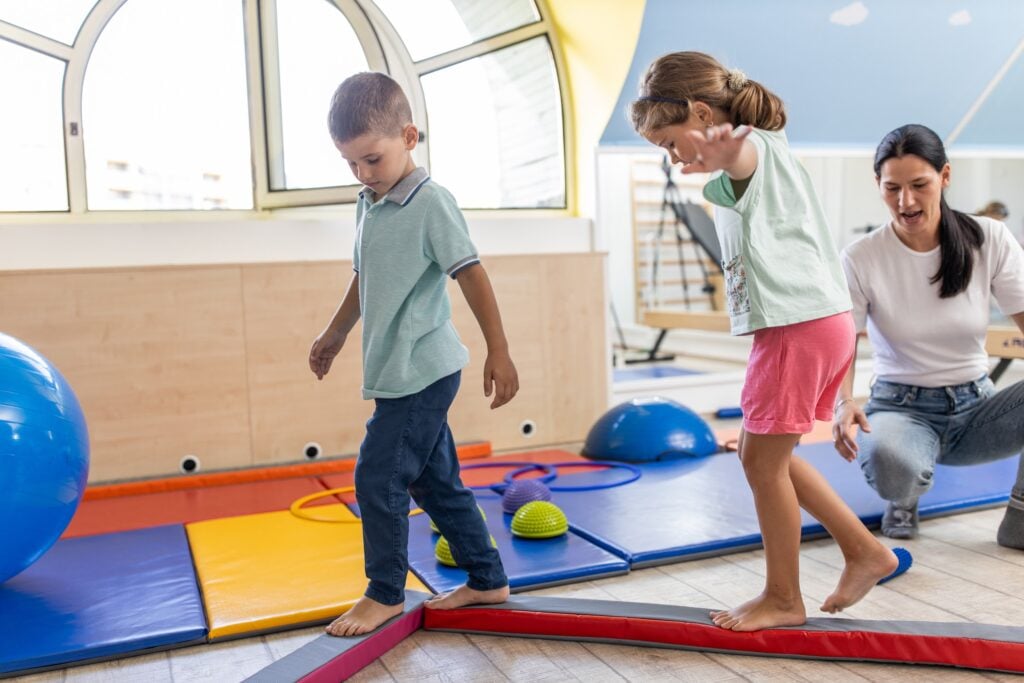
Does your child constantly bump into furniture, knock things over, trip over their own feet, or accidentally crash into other people?
It can be easy to brush these moments off as clumsiness, especially when they happen occasionally. But if your child seems to have trouble navigating their surroundings more often than other children their age, there could be more going on.
Moving safely through the world requires your child’s brain to keep track of where their body is, what’s around them, and how they need to move—all at the same time. When one or more of these skills are challenging, bumps, trips, and spills can happen much more frequently.
Body Awareness
Your child doesn’t have to look at their arms and legs to know where they are. Their brain constantly receives information from the muscles and joints that helps them understand the position and movement of their body. This is called proprioception.
When a child has difficulty processing this information, they might not always accurately judge where their body is in relation to the objects and people around them.
You might notice your child bumping into doorframes, standing too close to other people, using too much force during play, or accidentally knocking objects over.
Motor Planning and Dyspraxia
Knowing where your body is only part of the equation. Your child also has to figure out how to move it successfully.
Motor planning allows your child to think of, organize, and carry out movements, particularly when doing something new or unfamiliar. A child who has difficulty with motor planning might struggle to judge how to move around an obstacle, navigate playground equipment, or adjust their body quickly when something changes.
Significant difficulty planning and coordinating movement is sometimes described as dyspraxia. Children with dyspraxia can appear unusually clumsy because movements that become automatic for other children require much more conscious effort and planning.
Balance and Coordination
Walking across a crowded room, climbing stairs, running around the playground, and stepping over objects all require balance and coordination.
If these skills are still developing or are challenging for your child, they might trip frequently, lose their balance, or have difficulty adjusting their movements quickly enough to avoid something in their path.
Coordinating the two sides of the body can also affect how smoothly your child walks, runs, climbs, and participates in other physical activities.
Visual-Spatial Skills
Your child also needs to understand where objects are in relation to themselves and one another.
Visual-spatial skills help your child judge distances, navigate around obstacles, reach accurately for objects, and determine how much space they have to move.
When this information is difficult to interpret, your child might misjudge how close they are to the corner of a table, reach past an object, or have trouble navigating through crowded spaces.
How Can I Help My Child Develop Better Body Awareness?
Play gives children plenty of opportunities to practice navigating their environment and learning how their bodies move through space. Try activities such as:
- Completing obstacle courses
- Crawling through tunnels
- Climbing playground equipment
- Playing catch
- Practicing animal walks
- Dancing and copying different movements
- Playing games such as Simon Says
- Carrying, pushing, or pulling appropriately weighted objects
- Walking along balance beams or taped lines on the floor
Give your child time to practice without criticizing them for being “clumsy.” If navigating their environment is difficult, they might already be working much harder than you realize.
Occupational Therapy Can Help Your Child Move with Confidence
If frequent bumping, tripping, or falling is making everyday activities harder for your child, pediatric occupational therapy can help identify the skills contributing to the difficulty.
At Sensational Development, our occupational therapists use fun, play-based activities to help children develop body awareness, motor planning, balance, coordination, and other skills they need to move through their environment successfully.
Contact Sensational Development today to learn how occupational therapy can help your child move, play, and participate with greater confidence.
