

Children use their hands for countless activities throughout the day, and many of these everyday tasks rely on fine motor skills. When these skills are difficult, you might notice your child avoiding certain activities, taking longer to complete everyday tasks, or becoming frustrated when their hands won’t quite do what they want them to do.
So, how can you tell whether your child is simply still learning or could use some extra help developing their fine motor skills? Keep reading to learn more.
What Are Fine Motor Skills?
Fine motor skills involve the small, controlled movements of the hands and fingers. Children use these skills to grasp, pinch, manipulate, and release objects with control and precision.
But fine motor skills aren’t just about the hands! Your child also needs strength and stability through their shoulders, arms, and wrists to give their hands a steady foundation for movement. Vision, coordination, sensory processing, and motor planning can all play a role as well.
These skills develop gradually as children grow and gain experience using their hands during play and everyday activities.
What Activities Require Fine Motor Skills?
Fine motor skills are involved in more of your child’s day than you might realize. They help children participate in activities at home, at school, and during play.
Your child uses fine motor skills when they:
- Hold and use crayons, pencils, and markers
- Pick up small toys and objects
- Build with blocks or interlocking toys
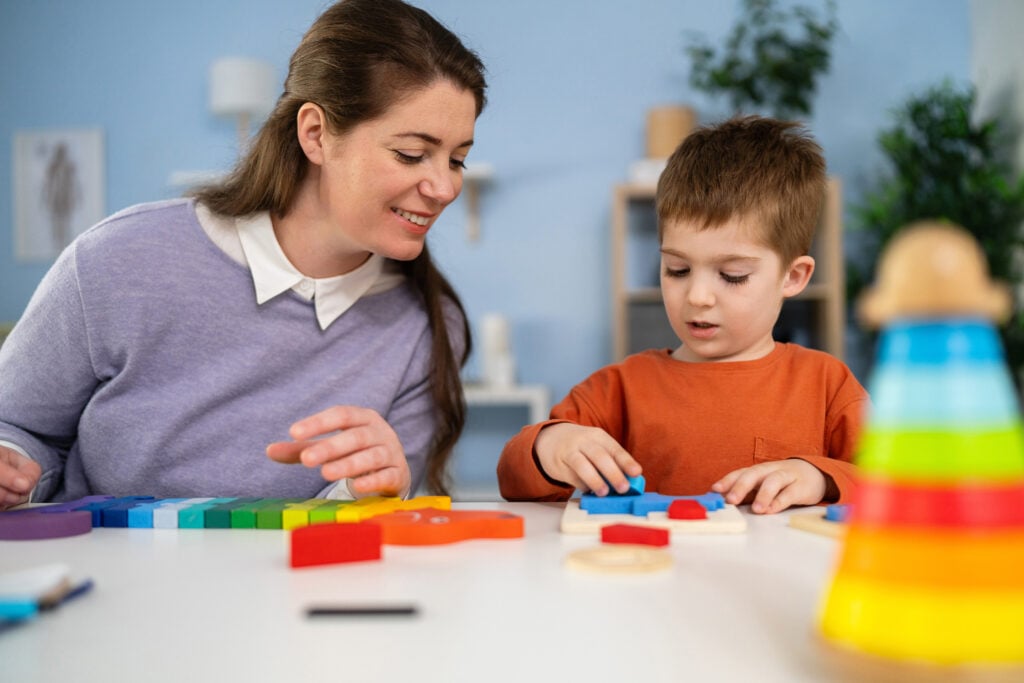
- Complete puzzles
- Use a spoon and fork
- Button, zip, and fasten clothing
- Brush their teeth
- Open containers and food packages
- Turn pages in a book
- Use scissors
- Type or use a touchscreen
As children get older, strong fine motor skills become increasingly important for independence with self-care, schoolwork, and other daily responsibilities.
What Can Fine Motor Difficulties Look Like?
Children develop skills at different rates, so struggling with one particular task doesn’t necessarily mean your child has a fine motor challenge. Instead, look for patterns across different activities and environments.
You might notice that your child:
- Avoids coloring, drawing, crafts, or other activities involving their hands
- Has difficulty manipulating small objects
- Frequently drops objects
- Struggles with buttons, zippers, or other clothing fasteners
- Has trouble using utensils independently
- Tires quickly during handwriting or other tabletop activities
- Uses an awkward or inefficient pencil or crayon grasp
- Has difficulty using scissors
- Needs more help with self-care tasks than expected for their age
- Becomes frustrated when completing activities that require precise hand movements
Sometimes the first sign isn’t the skill itself. Your child might simply say, “I can’t do it,” ask you to complete certain tasks for them, or avoid activities they find difficult.
How Can I Help My Child Develop Fine Motor Skills?
One of the best ways to strengthen fine motor skills is through play. Instead of turning practice into another chore, give your child plenty of opportunities to use their hands in fun and interesting ways.
Playing with play dough is a great place to start. Squeezing, rolling, pinching, and pulling the dough helps strengthen the hands and fingers. Building with blocks, stringing beads, completing puzzles, peeling and placing stickers, and picking up small objects with child-safe tweezers or tongs can also encourage fine motor development.
Everyday routines provide practice, too. Let your child help stir ingredients while cooking, open containers, pull up zippers, turn doorknobs, or carry and put away small items. Give them time to try tasks independently before stepping in to help.
Occupational Therapy Can Help Build Fine Motor Skills
If fine motor difficulties are making it harder for your child to participate in play, school, self-care, or other everyday activities, pediatric occupational therapy can help.
At Sensational Development, our occupational therapists look beyond the task your child is struggling with to understand the skills they need to be successful. Through fun, play-based activities, we can help your child build strength, coordination, dexterity, and confidence while working toward greater independence in their daily life.
Contact Sensational Development today to learn how occupational therapy can help your child develop the skills they need to participate, play, and become more independent.
